Make it easy

T

o encourage or allow someone to be truthful and blunt to you on your shortcomings, you must first lower your guard and perhaps start by sincerely confessing your weaknesses first.

A

s giving constructive feedback is not easy from even your best supervisors, Your self disclosure would infact make the other person feel at ease and comfortable in giving you a blatant opinion ; which is what you want to hear versus a feedback that is sugar coated with ambiguity and politeness.
It is a norm for many to be unable to give good constructive feedback face to face. Sadly though, sometimes, people are only great in “talking behind your back and not to your face.

Don’t be annoying …

Reflect on yourself, before you give advise to others ……

Are you doing what you preach ?
Do not teach when you can’t “do”.

#antihypocrite

Are you a great MANAGER ?

Enjoy reading the article below. I found it to be interesting. I especially liked points 1,3 and 5.

Willie

—————————————————————————————————————

Great bosses change us for the better. They see more in us than we see in ourselves, and they help us learn to see it too. They dream big and show us all the great things we can accomplish.

Great leadership can be a difficult thing to pin down and understand. You know a great leader when you’re working for one, but even they can have a hard time explaining the specifics of what they do that makes their leadership so effective. Great leadership is dynamic; it melds a variety of unique skills into an integrated whole.

One thing is certain—a leader’s actions are driven by his beliefs. It’s through a leader’s actions—and ultimately her beliefs—that the essence of great leadership becomes apparent.

“I am just a common man who is true to his beliefs.”   –John Wooden

Great leaders inspire trust and admiration through their actions, not just their words. Many leaders say that integrity is important to them, but only those leaders who truly believe it walk their talk by demonstrating integrity every day. Harping on people all day long about the behavior you want to see has only a tiny fraction of the impact that you achieve by believing so deeply in the behavior that you demonstrate it yourself.

Great bosses believe in their people, and this belief drives them to create an environment where people thrive. Let’s explore some of the driving beliefs that set great bosses apart from the rest of the pack.

1. Growth should be encouraged, not feared. Average bosses fear their smartest, hardest-working employees, believing that these individuals will surpass them or make them look bad. They hesitate to share information or to enable authority. Exceptional bosses, on the other hand,love to see their employees grow. They are always grooming their replacements and doing whatever they can to create leaders. Research shows that the number-one thing job seekers look for in a position is growth opportunity and that 80% of all job growth occurs informally, such as in conversations with managers. Exceptional bosses want their best employees to maximize their potential, and they know that good feedback and guidance are invaluable.

2. Employees are individuals, not clones. Average bosses lump people together, trying to motivate, reward, and teach everyone in the same way. Exceptional bosses treat people as individuals, respecting the fact that everyone has their own motivation and style of learning. Something different makes each employee tick, and the best bosses will stop at nothing to figure out what that is.

3. Employees are equals, not subordinates. Ordinary bosses treat their employees like children; they believe that they need constant oversight. These bosses think that their role is to enforce rules, make sure things run their way, and watch over people’s shoulders for mistakes. Exceptional bosses see employees as peers who are perfectly capable of making decisions for themselves. Rather than constantly stepping in, exceptional bosses make it clear that they value and trust their employees’ work and only intervene when it’s absolutely necessary.

4. Work can and should be enjoyable. Ordinary bosses see work as something that everyone has to do, whether they want to or not. They believe that their role is to make sure that their employees don’t slack off or grow lazy. They say things like, “If it weren’t for me, nothing would ever get done around here.” However, exceptional bosses love their jobs and believe that everyone else can too. They give people assignments that align with their strengths, passions, and talents. They celebrate accomplishments and douse people with positive feedback when they do good work.

5. Diversity, not like-mindedness, bears fruit, Average bosses want their employees’ ideas to align with their own, and because of this, they try to hire like-minded individuals. They encourage their employees to think similarly and reward those who “just put their heads down and work.” Exceptional bosses actively seek out a diverse range of individuals and ideas. They expose themselves and their companies to new ways of thinking.

6. Motivation comes from inspiration, not agony. Ordinary bosses think that strict rules and rule enforcement drive employees to work effectively. They believe that people need to fear layoffs, explosions of anger, and punishment in order to operate at 100%. People then find themselves in survival mode, where they don’t care about the product, the company, or the customer experience; they only care about keeping their jobs and appeasing their boss. Exceptional bosses motivate through inspiration—they know that people will respond to their infectious energy, vision, and passion, more than anything else.

7. Change is an opportunity, not a curse. Ordinary bosses operate by the motto, “This is the way we’ve always done it.” They believe that change is unnecessary and that it causes more harm than good. Exceptional bosses see change as an opportunity for improvement. They constantly adapt their approach and embrace change to stay ahead of the curve.

Bringing It All Together

If you’re currently a boss, is this how your employees would describe your beliefs? If not, you’re leaving money, effort, and productivity lying on the table. You’re also probably losing some good employees, if not to other jobs, then at least to disengagement and lack of interest

AUTHOR:

Travis Bradberry, Ph.D.

Dr. Travis Bradberry is the award-winning coauthor of Emotional Intelligence 2.0 and the cofounder of TalentSmart® the world’s leading provider of emotional intelligence tests and training serving more than 75% of Fortune 500 companies. His bestselling books have been translated into 25 languages and are available in more than 150 countries.

Do not intrude …..

Its a funny world.
Sometimes, people just want to be left alone.
They do not need your attention nor your services.
Thus, the more you do for them, the further they move away from you.
They may even find your kind gesture annoying / disturbing.
Its not that they do not care.
Nor are they heartless.
Its also not that they do not appreciate you.
It is simply that – they just WANT TO BE LEFT ALONE.
Learn when to serve and when to just watch.
When to speak and when to just listen.

Sometimes, it is best to just do NOTHING and even Ignore.

We need to respect their “space”.
#salespromoter #shopping #growingup #parents #teenagers #sensitivity

Reflection

Time to change …

Discard bad habits & behavior

For a better tomorrow ..

Do what has to be done.

Take charge ….
Correct it, if it is wrong. Add value to improve. That will change your destiny.

Do not be afraid to challenge the status quo ……
Stand up, be different and unique.

Listening ……it is so IMPORTANT

Great article below.

This is so true. In meetings …we can see leaders butting in and not allowing others to finish what they have to say. These leaders have in fact literally shut down their learning process. It is not uncommon that great ideas do come from one’s subordinates. In fact the people on the ground should know best  on improvements to be made and to contribute forward moving ideas.

Hence leaders should and must listen. This is one important way to grow.

Enjoy reading
Willie Low
http://www.passionsofwillie.com


listen.jpg

Article below by – Dr. C. Otto Scharmer is a senior lecturer at the Massachusetts Institute of Technology.

Listening is probably the most underrated leadership skill. How you listen can be life-changing; not just business- or industry-changing.

At the heart of most examples of colossal leadership failures — which are in no short supply — leaders are often unable to connect with and make sense of the “VUCA” world around them; that is, a world defined by volatility, uncertainty, complexity and ambiguity.

Listening is important to us as individuals, not solely to leaders. If you are not a good listener, there is no way that you can develop real mastery in any discipline.

In my work, the most consistent feedback we have received from the hundreds of workshops, programs and innovation journeys we have facilitated is this: Shifting your mode of listening is life-changing. Shifting how you listen, the way you pay attention, sounds like a really small change.

But here is the thing: Changing how you listen means that you change how you experience relationships and the world. And if you change that, you change, well, everything.

It is truly amazing how quickly people can shift their way of listening and attending. What I mean by “attending” is this: Wherever you put your attention as a leader, as an innovator, as a change maker, or as a parent, that is where the energy of the system around you will go — including your own energy.

But being a leader who listens takes work: practice, review, peer feedback and more practice. To become a better listener, you must understand the four archetypes of listening.

The four types of listening reflect the underlying principles of the opening of the mind, heart and will are:

  1. Dowloading: This type of listening is limited to reconfirming what we already know. Nothing new penetrates our bubble.
  2. Factual listening: We let the data talk to us and notice disconfirming information. Doing this requires opening the mind—that is, the capacity to suspend our habits of judgment.
  3. Empathic listening: We see the situation through the eyes of another. Doing this requires opening the heart: using our feelings and our heart as an organ of tuning in to another person’s view.
  4. Generative listening: We listen for the highest future possibility to show up while holding a space for something new to be born.

When you listen on Level 1, downloading, your attention is not focused on what the other person says but on your own inner commentary. For example, you may be planning what you will say next.

As you cross the threshold from downloading to factual listening (Level 1 to 2), your attention moves from listening to your inner voice to actually listening to the person in front of you. You open up to what is being said.

When you start to cross the threshold from factual to empathic listening (Level 2 to 3), your place of listening shifts from you to the other person. That is, from your small vehicle (the intelligence of your head) to your larger vehicle (the intelligence of your heart). You step into the other person’s perspective. For example, you might think, “Oh, I may not agree, but I can see how she sees this situation.”

Finally, when you cross the threshold from empathic to generative listening (Level 3 to 4), your listening becomes a holding space for bringing something new into reality that wants to be born. You listen with openness to what is unknown and emerging.

What I have learned in my work is that the success of leadership and change work — whether that’s organizational change, industry change or life-changing work — depends on the ability of you, the leader, to observe your quality of listening and to adjust the quality of listening to what is needed in each situation.


You ..

Whats important is “WHO YOU ARE”. And let others be who they want to be …….

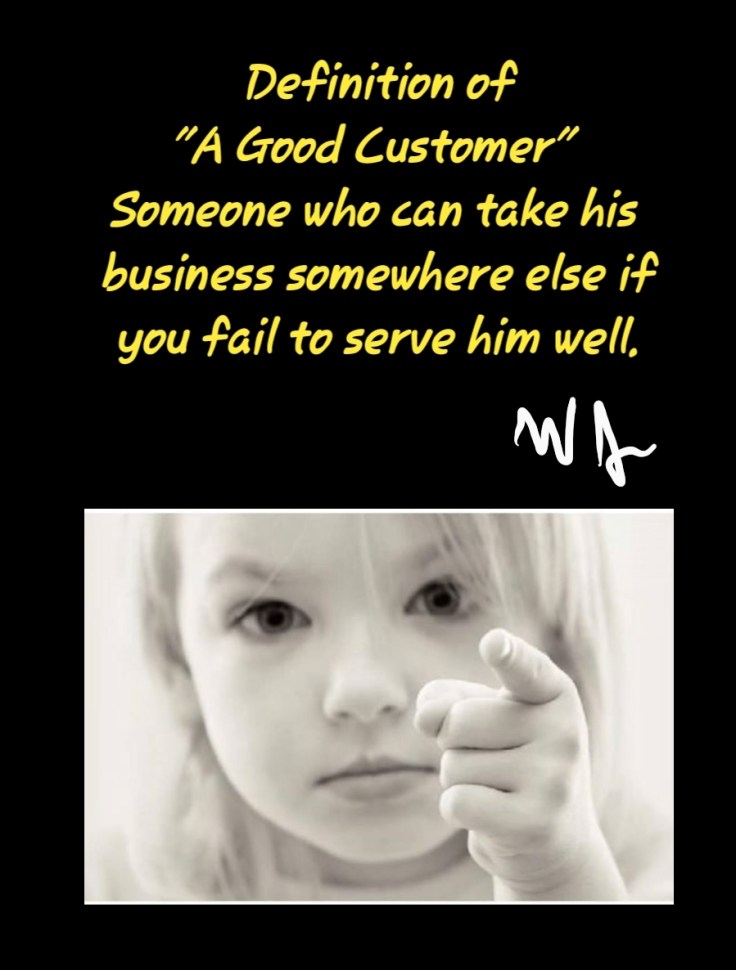
Good customer

Never take any customer for granted. Especially the good ones.

Sometimes ” familliarity” blinds us in keeping up our services, care and attention to him.

Blog at WordPress.com.

Up ↑